
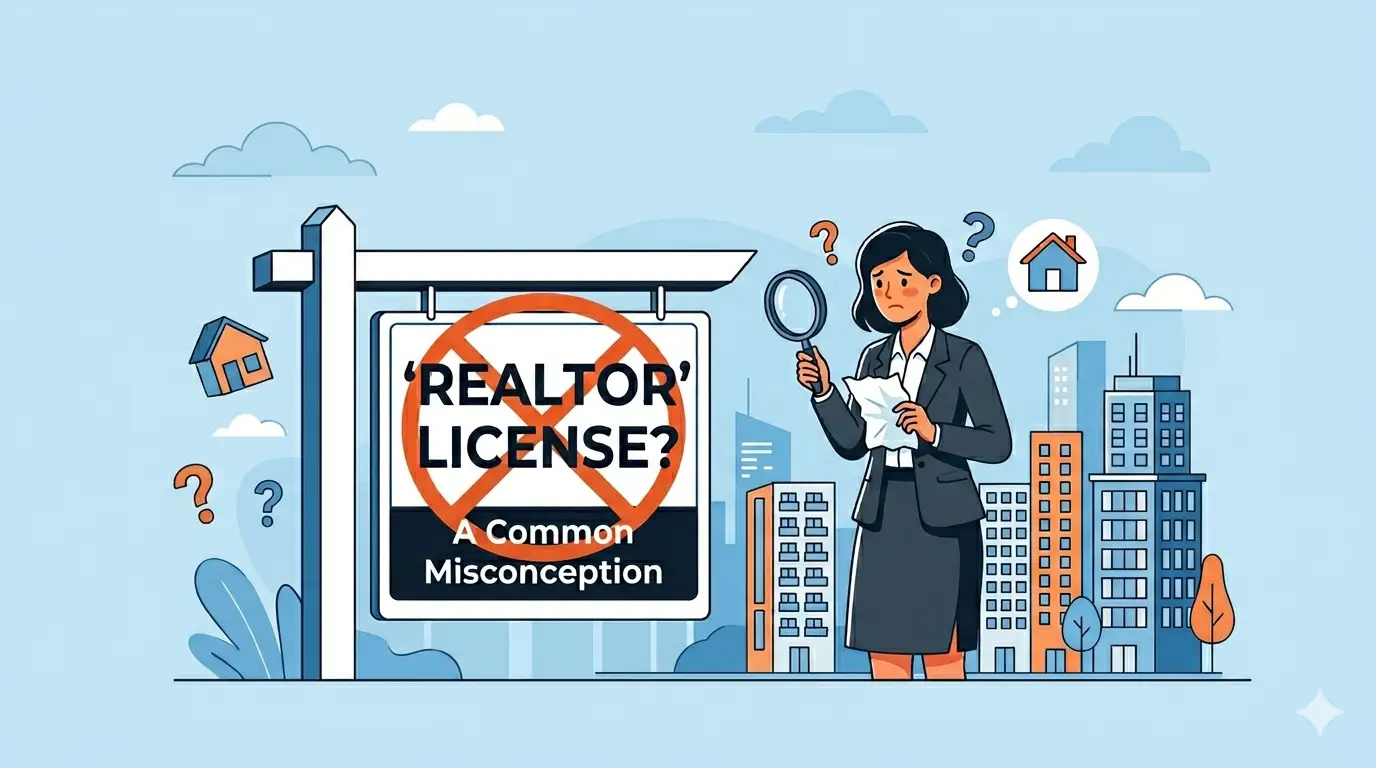
If you have ever heard someone say “I’m a licensed Realtor,” you have heard a phrase that feels normal, sounds professional, and is still wrong. The reason it keeps spreading is simple: the public has been trained to treat “Realtor” as a synonym for “real estate agent.” That is not what the word means. “Real estate agent” is tied to state licensing. “REALTOR®” is tied to membership in a private trade organization. Those are different categories, governed by different rules, and they carry different implications for consumers and for agents.
The cleanest way to understand it is this: a real estate license comes from the state and authorizes a person to perform regulated activities for compensation under that state’s laws. REALTOR® is a collective membership mark that identifies members of the National Association of REALTORS® (NAR). NAR itself is explicit that REALTOR® has a specific meaning tied to membership and not to licensure. When we blur those concepts, we end up with a marketplace where consumers cannot tell whether they are hearing a legal status, a marketing claim, or a trade association badge.
What you are actually licensed as
In the United States, real estate licensure is handled at the state level. That is why the legally meaningful descriptors tend to be things like “salesperson,” “sales associate,” or “broker,” depending on the state’s terminology. Those words matter because they connect to the state’s licensing framework and supervision rules. They are not branding. They are not optional. They describe a regulatory status that can be verified through the state licensing authority. REALTOR®, by contrast, is not a licensing tier and does not change a person’s authority to practice real estate under state law.
NAR even addresses this confusion directly by defining REALTORS® as licensed professionals who are also members of NAR, and by emphasizing that not all licensed agents are REALTORS®. That is the key distinction. The license is the baseline legal permission. The REALTOR® designation is an additional affiliation layered on top of that license. Conflating the two is how we got to “licensed Realtor,” a phrase that implies there is a special license category issued by someone other than the state. There is not.
What REALTOR® actually means, in plain English
NAR’s own materials frame REALTOR® as a membership indicator. In other words, the mark is supposed to tell the public, “This person is a member of NAR,” not “This person is licensed,” and not “This person is a type of agent.” That difference matters because membership marks exist to differentiate members from non-members. NAR describes the REALTOR® marks as being designed to distinguish members from non-member real estate professionals, and it treats the right to use those marks as a licensed benefit of membership.
Once you accept that this is a membership mark, a lot of sloppy marketing starts to look different. Saying “I’m a Realtor” is not a claim about licensing. It is a claim about belonging to a membership organization and, according to NAR’s framing, subscribing to its Code of Ethics. Whether that affiliation is valuable is a separate debate. The point is that the term has a defined meaning and the organization that owns the trademark expects it to be used in a way that preserves that meaning.
Why the public keeps getting it wrong
The public confusion is not surprising. The word “Realtor” is used constantly in pop culture, on portals, and in casual conversation as shorthand for “the person who sells houses.” NAR itself acknowledges the importance of “protecting the REALTOR® brand” because incorrect uses can mislead people about the meaning of the brand and weaken the association’s ability to protect the marks. That is a polite way of saying the same thing many consumers already feel: the term is treated like a generic job title even though it is not supposed to function that way.
There is also a practical history here. In many markets, association membership and MLS access were entangled for decades, which created the impression that “Realtor” was the default professional identity. But even if a market’s business infrastructure nudged people toward membership, that still does not turn REALTOR® into a license. Licenses come from the state. Membership comes from an organization. One is regulatory. One is associative. The marketplace works better when those labels remain accurate.
The side note most agents need to hear: NAR forbids descriptive uses of REALTOR®
Now for the part that almost nobody follows, even among people who are actually members.
NAR’s trademark rules expressly prohibit using descriptive words or phrases in connection with the REALTOR® marks. NAR even provides enforcement-oriented language that says descriptive-word usage is improper and must stop. That is not a blog opinion. That is how the mark owner says the mark must be used.
This is where phrases like “licensed Realtor,” “top Realtor,” “best Realtor,” “your Realtor for life,” “hungry Realtor,” and “Austin Realtor” run into trouble. Why? Because the moment you attach an adjective, a ranking, a vibe word, or a geographic descriptor to a membership mark, you are no longer using it as a membership identifier. You are using it as a descriptive job label or a marketing tagline. NAR’s guidance on trademark use online states plainly that the term REALTOR® may not be used with descriptive words or phrases, and it gives examples like “Number1realtor.com” as incorrect.
NAR’s own FAQ and training materials go even farther in the way they explain the underlying logic. They emphasize that “REALTOR®” must refer to membership and should not be used to denote an occupation or business, and they call out improper combinations with words like “your,” “my,” or “our,” plus other descriptive words. This is why “YourChicagoRealtorJohnDoe.com” is listed as an example of improper use in NAR’s internet guidance, and why mixing the mark with descriptive wording is treated as a violation of the rules that come with the membership license to use the mark.
If you want an even cleaner summary, one REALTOR® association blog that walks through NAR’s core rules states it bluntly: “Descriptive wording may not be used with the REALTOR® Marks,” and it lists prohibited descriptive wording as including geographic descriptors, adjectives, and words such as “my” and “your.” It also gives examples of improper usage like “Top Chicago REALTOR®” and “Jane the REALTOR®.” That aligns with NAR’s own rule framing and internet guidance.
“John Smith, REALTOR®” versus “licensed Realtor”
There is a difference between using the mark as an identifier adjacent to a member’s name and using it as a descriptor.
NAR’s Membership Marks Manual section on using the marks with a member’s name explains that the mark can be used with a member’s name if it complies with the rules, and it explicitly states that the mark must never be used with a descriptive term or as a vocational description such as a real estate broker, agent, or licensee. It also states the marks are not and may never be used as a designation of a person’s licensed status. Read that again because it is the whole issue: NAR says you cannot use REALTOR® to imply licensure.
So “John Smith, REALTOR®” is presented as an acceptable type of usage in that context, while “licensed Realtor” is the exact kind of phrase NAR says not to use because it turns a membership mark into a licensing claim. Even if the person is both licensed and a member, the phrase is still wrong because it describes REALTOR® as a license category rather than a membership mark. The difference is not semantics. It is the function of the mark.
Why this matters for consumers, not just trademark nerds
A consumer should be able to understand what a professional is claiming at a glance. “Licensed” is a regulated status with a government enforcement mechanism behind it. “Member” is an affiliation with private rules and private enforcement. Those are both real things, but they are not interchangeable, and they should not be mashed together into a single phrase that sounds official while being conceptually inaccurate. When the marketplace is sloppy with language, it becomes harder for consumers to evaluate competence, accountability, and recourse if something goes wrong.
Even NAR’s own brand-protection messaging acknowledges that incorrect uses can mislead people about the meaning of the brand. The point is not that every misuse is a grand conspiracy. The point is that the misuse produces the same outcome: the public gets the impression that REALTOR® is a state-recognized license level or a professional rank. It is not. It is membership.
Why this matters for agents and brokerages
If you are an agent, accuracy in advertising and self-description is part of professionalism. You can describe what you are licensed as, and you can describe what organizations you belong to, but you should not describe a membership badge as if it were a license issued by the state. NAR’s manual is clear that REALTOR® should not be used as a vocational description or as a designation of licensed status. If you are going to use the mark, you should use it the way the mark owner says it must be used.
If you are a brokerage owner, you should care for an additional reason: consistency. Your agents’ marketing language becomes your brokerage’s reputational footprint. When a brokerage allows loose language that implies credentials that do not exist, you end up in a trust deficit with the exact consumers you are trying to serve. You also create internal confusion among agents about what matters legally versus what is simply affiliation. A business that prides itself on clarity should treat words the way regulators and trademark owners treat them: as signals with real meanings.
Where Easy Realty stands on this
At Easy Realty, we are not interested in pretending that a trade association membership is the same thing as a state license. Consumers deserve clarity, and agents deserve to understand their own professional identity without borrowed labels. You can be an exceptional licensed real estate professional without being a REALTOR®, and you can be a REALTOR® and still need to earn trust the same way everyone else does: by competence, transparency, and execution. The label is not the work.
That is why we prefer plain English. If you are licensed, say you are licensed. If you are a broker, say you are a broker. If you are a member of an organization, say you are a member. And if you are going to use someone else’s trademark, follow their rules, especially when those rules explicitly prohibit descriptive phrases and prohibit using the mark as a proxy for licensure.
The takeaway
There is no such credential as “licensed Realtor.” Licenses come from the state. REALTOR® is a membership mark owned by NAR. Even more importantly, NAR’s own trademark rules say you cannot use REALTOR® with descriptive terms, and you cannot use it to describe your licensed status. If the industry wants consumers to trust it more, we can start by using words correctly and stopping the sloppy, misleading shorthand that benefits marketing while confusing the public.