
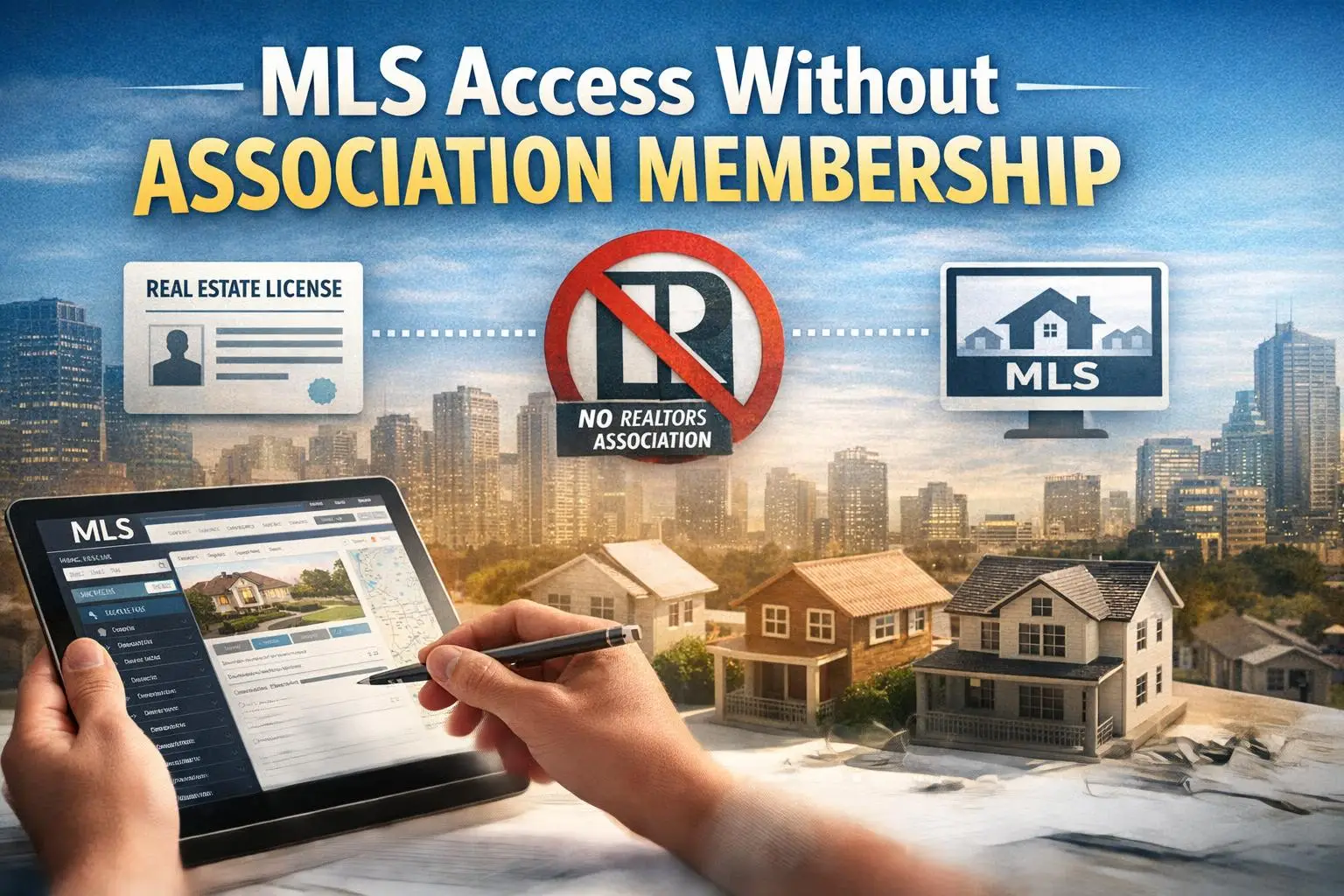
Most real estate agents don’t actually understand how MLS access without association membership works. That’s not their fault. The way the industry has been structured for decades makes it feel like everything is tied together when it isn’t. You get your license, you join a brokerage, you pay your dues, and suddenly you have MLS access. It all happens in one sequence, so it looks like one requirement.
But it’s not.
What most agents were given is a bundled system, not a clear explanation. Licensing, association membership, and MLS access were packaged together for convenience, compliance, and revenue. Over time, that packaging turned into belief. And that belief turned into industry “truth.”
This post breaks that apart completely. We’re going to go layer by layer so you can understand what actually controls MLS access, why association membership was historically tied to it, and how agents today are accessing the MLS without paying for things they don’t need.
Once you see the structure, you won’t unsee it.
Executive Summary
Most agents believe MLS access requires joining a Realtor association. That belief has been reinforced by nearly every brokerage model in the country, but it is not a legal requirement. It is a structural one.
The real estate industry bundled three separate components into one experience. Your real estate license comes from the state. Association membership is a voluntary relationship with a private trade organization. MLS access is granted by a local entity that operates a database. These three things operate independently, even though they are often presented as one system.
The key to understanding MLS access is recognizing who actually controls it. It is not NAR. It is not your license. It is the MLS operator and, more importantly, your broker’s relationship with that MLS. Agents do not typically access the MLS on their own. They gain access through the brokerage they are affiliated with.
What has changed in recent years is that the industry is beginning to unbundle. Policy updates have shifted control away from national-level requirements and toward local MLS discretion, meaning access is increasingly determined at the local level rather than being universally tied to association membership.
Once you understand this structure, you can see why some agents are now choosing brokerage models that provide MLS access without requiring association membership. This is not a workaround. It is simply the system operating the way it was always allowed to operate.
The Biggest Misconception in Real Estate
Ask most agents how MLS access works and you will get the same answer. They’ll tell you they need to be a Realtor to access the MLS. They’ll say that joining the association is part of being licensed. Some will even say the MLS is owned by NAR.
None of that is actually accurate.
These beliefs exist because of how agents enter the business. No one sits them down and explains the structure. Instead, they join a brokerage that already has everything set up. The brokerage hands them a checklist. Join the association. Pay your dues. Get MLS access. It all happens together, so it feels like one requirement.
What they’re experiencing is not dependency. It’s sequence.
Just because something happens together does not mean it must happen together. That distinction is where most of the confusion lives. The industry trained agents to follow a process, not to understand the system behind it.
What the MLS Actually Is
There is no single MLS. That’s one of the first things most agents misunderstand.
In the United States alone, there are hundreds of regional MLS systems, each operating independently with its own rules, coverage area, and governance structure. These systems are not controlled by one central authority. Some are owned by Realtor associations. Others are owned by brokers. Some are independently operated entities.
At its core, the MLS is a database. It is a shared system that allows brokers to pool listings, share information, and cooperate with one another. That’s it. It is not a licensing body. It does not grant you the ability to practice real estate. It does not regulate your business outside of its own participation rules.
Once you strip away the branding and the history, the MLS is a tool. A very powerful tool, but still just a tool.
Who Actually Controls MLS Access
This is where most agents have their first real shift in understanding.
MLS access is controlled by the MLS operator. Not by NAR. Not by your real estate license. Not by your personal membership in an association.
The MLS decides who can participate, what the requirements are, and how access is granted. In most cases, participation is granted to brokers, not individual agents. Those brokers are referred to as participants, and they carry responsibility for everything that happens under their access.
Agents, in most structures, are considered subscribers. They do not independently join the MLS. They access it through their broker. This is why your experience as an agent is shaped entirely by the brokerage you choose.
If your broker is structured one way, you inherit that structure. If your broker is structured differently, your requirements change with it.
That’s the real control point. Not your individual decision, but your broker’s relationship with the MLS.
Why Association Membership Was Historically Required
To understand where we are now, you have to understand how the system was built.
Historically, most MLS systems were owned and operated by local Realtor associations. That ownership created a bundled model. If you wanted access to the MLS, you joined the association because the association controlled the MLS. The two were packaged together by design.
This bundling served multiple purposes. It simplified administration. It ensured consistent participation rules. It created stable revenue for associations. And it gave associations significant control over market access.
At the broker level, this became even more rigid. If a broker joined the association, that broker typically had to ensure that everyone under their license also joined. This was not about legal necessity. It was about maintaining a consistent structure across the office and complying with the way the MLS participation was defined.
By the time an agent entered the business, the decision had already been made. They weren’t choosing whether to join. They were inheriting a system where the choice had already been removed.
What Changed Recently and Why It Matters
The industry has been under increasing legal and competitive pressure to separate these systems. As part of broader policy changes, the requirement tying MLS access directly to association membership has been removed at the national level, shifting decision-making authority to local MLS organizations.
This is a significant structural change.
Instead of one blanket rule, each MLS now has the ability to decide how access works. Some still maintain traditional requirements. Others are introducing non-member subscription options. Others are separating MLS access entirely from association membership.
This shift is already happening in multiple markets, with MLS organizations offering access to licensed agents who are not members of a Realtor association.
What matters is not that every MLS has changed overnight. What matters is that the model is no longer locked. The system is opening up.
How You Actually Get MLS Access Without Membership
The process itself is straightforward once you understand the structure.
First, you need an active real estate license. This is issued by the state and is required to legally practice real estate. It has nothing to do with NAR or any association.
Second, you must be affiliated with a broker who is a participant in the MLS. Agents do not typically gain MLS access independently. The broker holds the relationship with the MLS and extends that access to agents under their supervision.
Third, the broker determines the structure. If the broker is a member of a Realtor association and participates in the MLS under that structure, agents are usually required to join as well. If the broker participates as a non-member, then that requirement may not exist.
Fourth, the MLS must allow access without association membership. Many now do, offering subscription-based access to licensed professionals without requiring Realtor affiliation. Some still require additional agreements or different fee structures.
The key takeaway is that access is not determined by you alone. It is determined by the combination of your broker’s model and the MLS’s rules.
The Broker Is the Real Decision Maker
Most agents think they are choosing their business model. In reality, they are choosing a brokerage, and that brokerage defines the rules they operate under.
If your broker is a Realtor, you are typically required to be one as well. If your broker is not, that requirement often disappears. The agent rarely has the ability to override this structure.
That means your cost structure, your obligations, and even your perception of what is “required” are all influenced upstream.
Understanding this changes how you evaluate brokerages. You are not just choosing a brand or a split. You are choosing a system.
The Rise of MLS-Only and Non-Realtor Brokerages
As MLS access becomes more flexible, new brokerage models are emerging.
Some MLSs have long allowed non-Realtor participation, especially those that are broker-owned or independently operated. Others are now introducing MLS-only subscription models that separate access from association membership entirely.
This creates room for brokerages to build models that focus on access and efficiency rather than bundled services. Instead of forcing agents into one structure, they allow agents to choose what they actually use and pay accordingly.
This is not a fringe concept. It is an emerging direction for the industry.
What You Lose and What You Don’t
One of the biggest fears agents have is that they will lose access to essential tools if they step away from association membership.
That is not how it works.
If your MLS allows it and your broker is structured correctly, you still have full access to the MLS. You can search listings, enter listings, and cooperate with other agents. The core functionality of your business remains intact.
What you may lose are the additional services tied to association membership. That could include networking events, educational discounts, branding under the Realtor name, and access to certain proprietary tools.
For some agents, those things matter. For others, they do not.
The important distinction is choice. You are not losing access to real estate. You are choosing what you want to pay for.
Cost Breakdown and Structure
In the traditional model, costs are bundled together. You pay association dues, state dues, national dues, and MLS fees, often without clearly separating what each component provides.
In an unbundled model, those costs are separated. You pay for MLS access directly and decide whether association membership is worth it to you.
This shift makes costs visible. And once costs are visible, they become optional.
Why This Shift Is Accelerating
The change is being driven by multiple forces at once.
Legal pressure has challenged the idea of tying access to membership. Market competition is pushing MLSs to attract more subscribers. Brokers are experimenting with new models. And agents are becoming more aware of how the system actually works.
Once agents understand that MLS access and association membership are not inherently linked, it changes how they evaluate every cost in their business.
How This Impacts Agents
This shift gives agents more control.
They can choose brokerages based on structure instead of tradition. They can evaluate costs more clearly. They can build their business around what they actually use instead of what they were told they needed.
It also introduces responsibility. With more choice comes the need to understand the system, not just follow it.
How Easy Realty Fits Into This Model
Everything outlined in this article is not theoretical. It is already being implemented.
Easy Realty operates as a non-Realtor brokerage. That means MLS access is structured without requiring association membership. Agents are not forced into bundled costs. Instead, the model focuses on providing MLS access, support, and a transparent fee structure.
The goal is simple. Remove unnecessary requirements, reduce overhead, and give agents control over how they operate.
The Bottom Line
MLS access does not come from the National Association of Realtors. It does not come from your license. It comes from the MLS and your broker’s relationship with it.
For decades, the industry bundled access with association membership. That bundling made the two feel inseparable. But they were never the same thing.
Now that the system is unbundling, agents have a choice. And once you understand how it actually works, you can decide what you need and what you don’t.
Most agents were never given that clarity.
Now you have it.
Key Takeaways
- MLS access is controlled by local MLS organizations
- Association membership is separate from licensing and MLS participation
- Brokers determine how agents access the MLS
- Non-member MLS access is increasing across many markets
- The industry is shifting toward unbundled, flexible models
FAQs: MLS Access Without Association Membership
Can you access the MLS without being a Realtor
Yes, in many markets licensed agents can access the MLS without joining a Realtor association, depending on the MLS rules and their broker’s structure.
Do you need NAR membership to use the MLS
No. NAR does not grant MLS access. The MLS operator determines access requirements.
Why do most agents still join Realtor associations
Because their brokerage participates in the MLS through an association-based structure that requires it.
What is an MLS-only subscription
It is a subscription model that provides access to the MLS without requiring association membership, typically offered by certain MLS organizations.
Who actually controls MLS access
The MLS operator controls access, and brokers determine how that access is extended to agents.