
The Industry Changed, But the Structure Didn’t
Florida MLS fragmentation is one of the most misunderstood and overlooked issues in real estate today. Most agents operate inside this system without ever questioning why there are so many MLSes across the state, how they actually function, or whether the structure still makes sense. For decades, everything was bundled together, and that model went largely unchallenged.
The problem is that this model was built for a completely different era. It was built before the internet made data instantly accessible, before transactions could be managed digitally, and before agents had the ability to operate independently of local physical infrastructure. Over the past two years, one of the core pillars supporting that legacy system has completely disappeared, and the rest of the structure has not adjusted at the same pace.
The MLS Lost Its Most Important Function
The biggest shift in real estate was not marketing, branding, or even brokerage structure. It was the removal of compensation from the MLS. Historically, the MLS was not just a place where listings were stored and shared. It was the central mechanism that allowed agents to communicate commission splits, structure cooperation, and align expectations between listing agents and buyer’s agents before a transaction even moved forward.
That function has now been removed. Following the 2024 NAR settlement, MLS systems are required to eliminate compensation fields and prohibit the communication of commission offers within the platform. Compensation is still part of the transaction, but it is now negotiated separately through contracts and direct communication between the parties involved rather than being embedded in the listing itself.
This change fundamentally altered what the MLS actually is. It removed the financial coordination layer that made MLS participation feel mandatory and left behind a system that is far more mechanical than most agents have been taught to believe.
What the MLS Actually Does Today
If you strip away the historical narrative and look at the MLS as it functions today, it becomes much easier to understand. At its core, the MLS is now a structured database combined with a compliance framework. It aggregates property listings, distributes that information to brokerages and third-party platforms, and enforces rules around how listings are entered, updated, and maintained.
Those rules still matter. The MLS ensures that listings are accurate, that required disclosures and agreements are in place, and that data is standardized in a way that allows it to be used across multiple platforms and systems. It enforces timelines, validates information, and maintains consistency throughout the marketplace.
What it no longer does is manage the financial relationship between agents. That shift is critical, because it removes the primary reason the system had to be controlled so tightly in the first place.
Florida’s MLS Fragmentation Makes Less Sense Than Ever
Florida MLS fragmentation did not come from a strategic decision to optimize efficiency. It is the result of how the industry evolved over time.
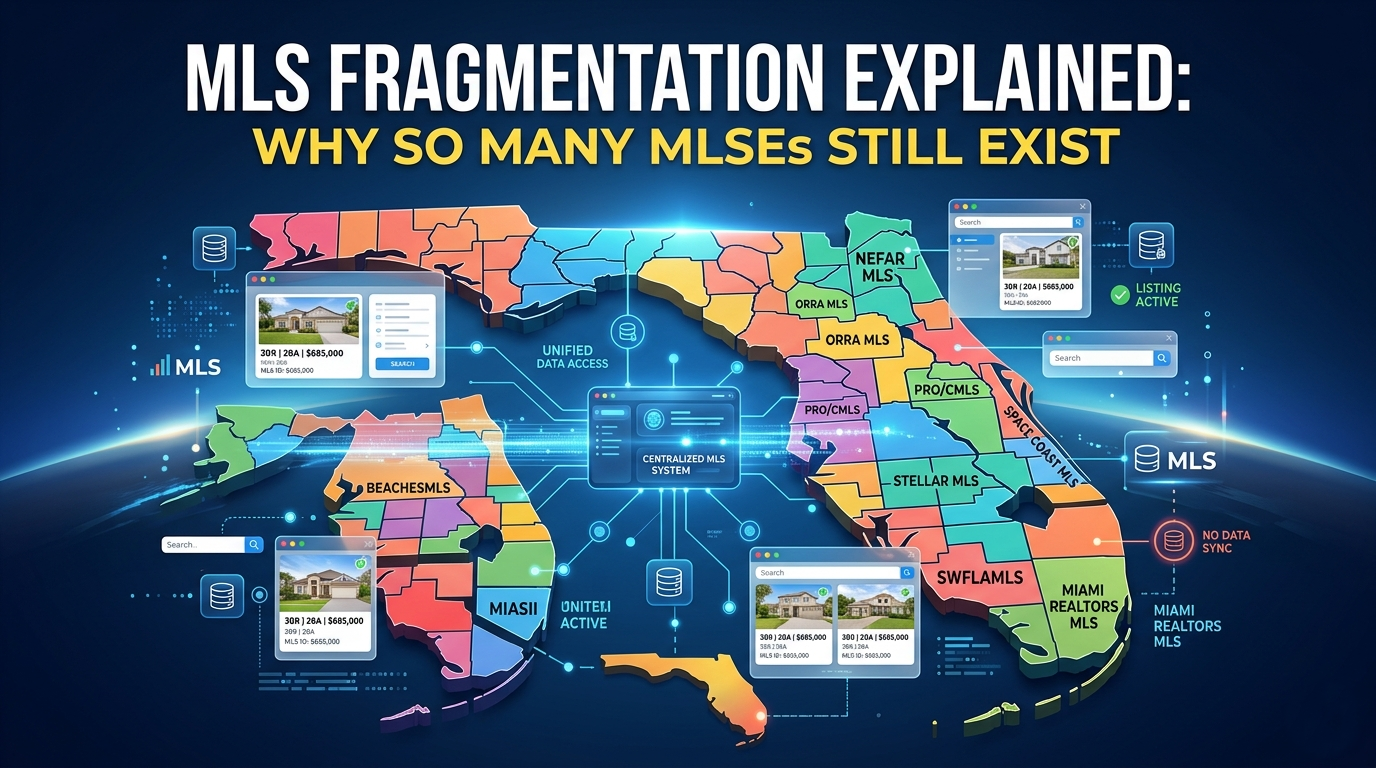
Once you understand what the MLS does today, the fragmentation across Florida becomes much harder to justify. The state operates with dozens of MLS organizations, many of which cover overlapping or adjacent geographic areas that are separated by short driving distances. At the same time, Florida maintains more than fifty local Realtor associations, each with its own governance, fee structure, and operational footprint.
This structure did not come from a strategic decision to optimize efficiency. It is the result of how the industry evolved over time. MLS systems were originally built at a local level because that was the only way to coordinate listings, distribute information, and enforce cooperation when everything was physical. Offices were necessary. Local governance was necessary. Data could not be shared easily across regions.
That is no longer the case, but the structure remains because it has not been forced to change.
Why the System Hasn’t Consolidated
The reason Florida MLS fragmentation persists today has very little to do with technology and everything to do with control, revenue, and legacy structure.
There is no technical barrier preventing Florida from operating on a more unified MLS structure. The barriers are organizational. Each MLS operates as its own entity with its own leadership, its own revenue streams, and its own decision-making authority. Consolidating into a statewide system would require those organizations to give up a level of control and agree on how revenue is distributed, which is a far more complex challenge than simply aligning technology.
Revenue plays a major role in maintaining the current structure. MLS systems and local associations generate income through dues, access fees, and related services. Those funds support operations, staff, and infrastructure at the local level. Consolidation would not eliminate that revenue, but it would redistribute it, and that becomes a negotiation that many organizations are not willing to enter into willingly.
As a result, fragmentation continues, not because it is necessary, but because it persists.
Why This Matters More Now Than It Did Before
The impact of Florida MLS fragmentation matters far less than it used to, because the MLS no longer controls compensation.
Before 2024, the MLS controlled both data and compensation, which made participation feel inseparable from the act of doing business. That is no longer the case. Data still flows through the MLS, but compensation has been decoupled and moved into contracts, which means the MLS no longer defines the structure of the transaction itself.
This creates flexibility that did not exist before. Agents are no longer locked into one system as tightly as they once were, and the role of the brokerage becomes more important in determining how agents interact with MLS platforms. Instead of the MLS dictating how business is done, brokerages now have the ability to design systems that align with how their agents actually operate.
How Easy Realty Approaches MLS Access
Easy Realty operates inside this new reality rather than the legacy model. We are active members of multiple MLS systems, including Stellar MLS, Beaches MLS, Southwest Florida MLS, Realtor-affiliate MLSes, and My State MLS (state-wide), which allows us to provide broad coverage across key markets without being tied to a single local system. That multi-MLS structure gives our agents flexibility in where and how they operate without forcing them into unnecessary limitations.
What makes our model different is that MLS participation is not treated as a requirement. Agents can choose to join with MLS access or without MLS, depending on their business model, or preference. Some agents need consistent MLS access because they are actively listing and selling properties within structured local markets. Others operate a DTC model skipping the Buyer’s Agentprimarily through referrals, off-market opportunities, or specialized niches where MLS usage is limited or intermittent.
Forcing both types of agents into the same cost structure doesn’t reflect how the business actually works today. By making MLS access optional, we align costs and tools with real usage rather than assumptions about what an agent should be doing.
MLS as a Tool, Not a Foundation
The most important mindset shift is understanding that the MLS is no longer the foundation of a real estate business. It is a tool. It is an important tool, especially for listing exposure, data access, and compliance, but it is no longer the mechanism that defines how deals are structured or how agents are compensated.
When compensation was controlled within the MLS, participation dictated behavior. Now that compensation is negotiated independently, participation becomes a choice, and that changes the role the MLS plays in an agent’s day-to-day business.
What Happens Next
The fragmentation in Florida is unlikely to remain unchanged indefinitely. Over time, consolidation, data sharing agreements, and regional mergers will continue to reduce the practical impact of having multiple MLS systems. We are already seeing larger organizations combine and expand their footprint, creating more unified experiences even within a fragmented structure.
However, the more important evolution is not whether there will be one MLS or thirty. It is the shift in where control sits within the industry. Control is moving away from centralized systems that dictate how business is done and toward brokerages and agents who can choose how they operate within the available infrastructure.
Final Thought
Understanding Florida MLS fragmentation is no longer just industry trivia. It directly impacts how agents choose brokerages and structure their business.
The real question is no longer whether the MLS should be consolidated. The real question is why anyone is still structuring their entire business around it.
The rules have changed. The economics have changed. The transaction structure has changed.
At Easy Realty, we built our model around those changes. Not by rejecting the MLS, but by recognizing that it is no longer the center of everything. It is one component in a much larger system, and agents who understand that shift early will have a significant advantage over those who continue to operate inside a model that no longer exists.