
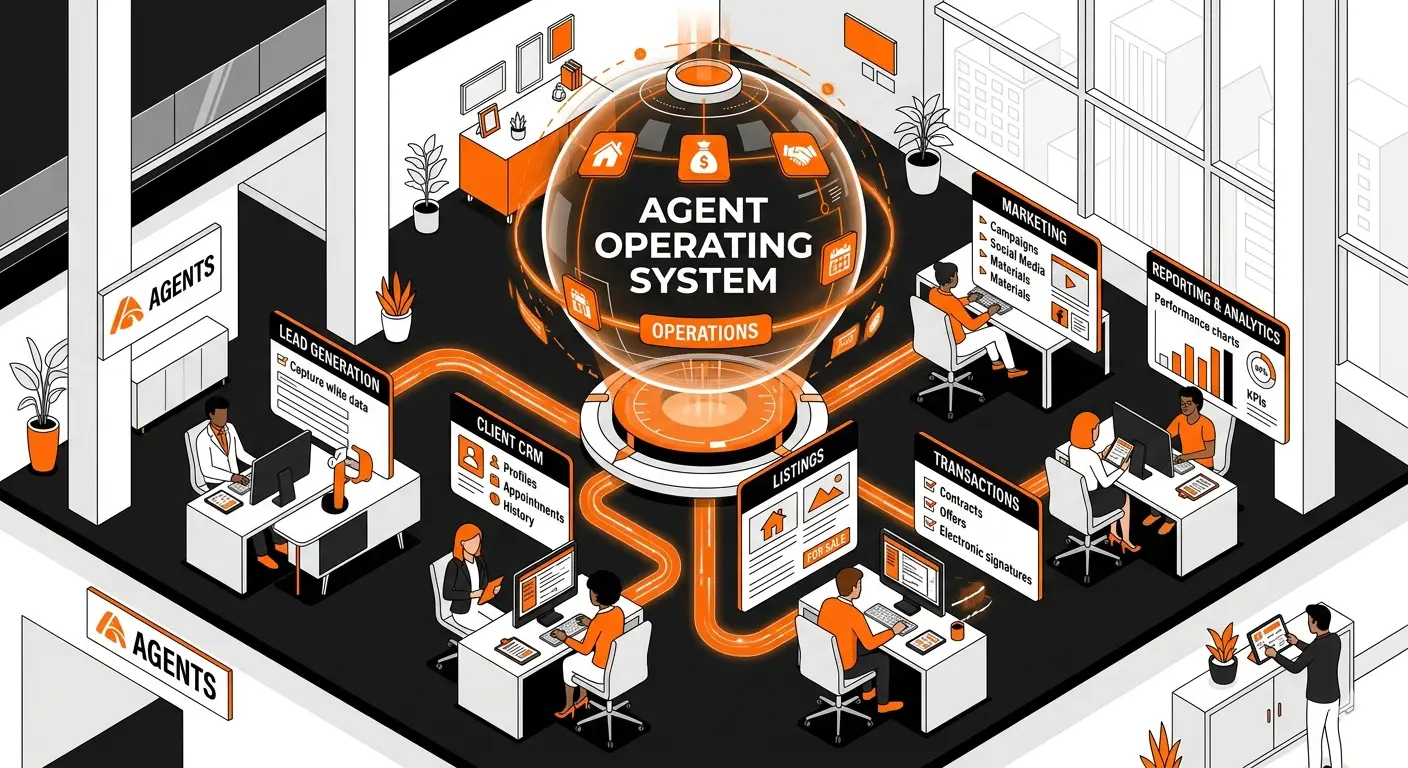
The real estate agent operating system is what separates average agents from agents who scale consistently.
Most real estate agents still believe they’re joining a brokerage. That mindset alone is holding them back.
What they are actually doing is plugging themselves into a system. The brokerage determines the structure, but the system determines the outcome. It controls how business is generated, how deals are managed, how clients are followed up with, and ultimately how much the agent earns.
In today’s market, the difference between an average agent and a high-performing agent is no longer effort alone. It is infrastructure. The agents who are winning today are not necessarily working harder. They are operating inside better systems.
That system has a name, even if most agents have never thought about it that way.
It is the real estate agent operating system.
What Is an Agent Operating System
An Agent Operating System is the complete framework that runs an agent’s business from start to finish. It is not one tool. It is not just a CRM login or a transaction platform. It is the combination of tools, workflows, automation, and structure that governs how an agent produces results every day.
It spans the entire lifecycle of a real estate business.
From the moment a lead is captured to the moment a transaction closes and beyond, everything should flow through a single, cohesive system. That includes lead generation, follow-up, communication, transaction management, documentation, compliance, and performance tracking.
Modern brokerages no longer compete based on brand recognition or office presence alone. They compete based on how effective their operating systems are. The best brokerages in today’s environment understand that agents do not just need support. They need infrastructure.
Why the Industry Is Shifting Toward Systems
Real estate has become more complex, more competitive, and more digital. Clients expect speed, consistency, and professionalism at every touchpoint. At the same time, agents are managing more leads, more transactions, and more moving parts than ever before.
The traditional approach cannot keep up with that complexity.
Many agents are still using a fragmented collection of tools. A CRM for contacts, a separate platform for marketing emails, another system for transactions, spreadsheets for tracking deals, and a calendar for everything else. None of these systems are truly connected. Data has to be entered manually across platforms, and important information often slips through the cracks.
This is not a productivity issue. It is a system design issue.
Research shows that agents can spend hundreds of dollars per month on disconnected tools that do not integrate with one another, leading to inefficiency, duplicated effort, and missed opportunities.
As the market evolves, this approach becomes less sustainable. The shift toward integrated systems is not optional. It is inevitable.
The Difference Between Tools and Systems
This is where most agents get it wrong. They believe they need better tools, so they keep adding more.
A new CRM. A new marketing platform. A new lead source.
But tools alone do not create leverage.
A system does.
A system is what happens when those tools are connected, structured, and designed to work together. It removes duplication. It reduces friction. It creates consistency. Instead of the agent managing the tools, the system manages the workflow.
The difference is significant.
An agent with tools still has to remember what to do next. An agent with a system knows that the next step is already handled.
The Core Components of an Agent Operating System
Every effective Agent Operating System is built on a small number of foundational components. These components are not optional. They are the pillars that everything else depends on.
The CRM as the Command Center
At the center of the system is the CRM. It is not just a database of contacts. It is the control center of the entire business.
A properly configured CRM tracks every lead, every interaction, and every stage of the pipeline. It stores not just names and numbers, but complete histories of conversations, actions taken, and next steps required. More importantly, it automates follow-up so that no lead is ever forgotten.
CRM systems are essential because they centralize communication, prioritize follow-ups, and provide visibility into the entire sales pipeline. [houzeo.com]
Without a strong CRM at the core, the rest of the system cannot function effectively.
Lead Generation and Marketing Automation
Once the CRM is in place, the next layer is lead generation and marketing automation.
In the past, agents generated business manually. Prospecting, cold calling, and networking were the primary drivers. Those activities still matter, but modern systems amplify them.
An effective operating system includes automated lead capture from websites, landing pages, and campaigns. It includes email marketing that nurtures prospects over time. It includes text messaging sequences and digital campaigns that keep the agent in front of clients without constant manual effort.
Marketing tools are no longer optional add-ons. They are integrated components that feed directly into the CRM and maintain consistent engagement with prospects. [ranolarealestate.com]
This is where scale begins. Without automation, growth is limited by time. With it, growth becomes consistent.
Transaction Management and Deal Flow
If the CRM controls the pipeline, the transaction system controls execution.
Every deal involves dozens of steps. Documents must be collected. Deadlines must be met. Compliance requirements must be satisfied. Multiple parties must be coordinated.
Transaction management software creates structure around that process. It tracks every stage from contract to closing, ensures all documentation is complete, and provides visibility into deal progress. It is what turns a chaotic process into a repeatable workflow. [smartagent…liance.com]
Without this layer, even strong agents struggle to maintain consistency as their volume increases.
Workflow Automation
Automation is the layer that connects everything together.
It removes repetitive tasks from the agent’s workload and replaces them with predefined processes. Follow-up emails are sent automatically. Tasks are assigned when certain actions occur. Notifications are triggered when deadlines approach.
This is what allows a single agent to operate at a higher level without adding staff.
Automation shifts the agent’s focus away from administrative work and toward high-value activities such as client relationships and negotiations. [usrealtytraining.com]
Reporting and Visibility
The final component of a true operating system is visibility.
Agents cannot improve what they cannot measure. A modern system provides clear insights into performance. It shows how many leads are being generated, how many are converting, how long deals are taking, and where opportunities are being lost.
It replaces guesswork with data.
With proper reporting, an agent is no longer reacting to their business. They are actively managing it.
Why Most Brokerages Fall Short
Despite the importance of these systems, most brokerages still do not provide a true operating system.
They provide pieces.
Agents may receive access to a CRM. They may be given a transaction platform. They might have training sessions or access to templates.
But the integration is missing.
There is no unified workflow. There is no clear structure. There is no system architecture that ties everything together.
As a result, the agent is left to build their own operating system. Most do not have the time, knowledge, or resources to do that effectively. They end up with fragmented tools and inconsistent processes.
This is one of the biggest inefficiencies in the industry today.
Studies of brokerage technology stacks show that many firms rely on multiple separate tools across dozens of functions, creating unnecessary cost, duplicated work, and operational friction. [I need abo…it with Gr | Word]
What a Real System Feels Like
When an agent operates inside a true system, the difference is immediate.
Leads are captured automatically and routed correctly. Follow-up is consistent and predictable. Transactions move through structured workflows with clear deadlines and responsibilities. Communication is centralized and easy to track.
The agent no longer spends time wondering what to do next. The system defines the process.
Over time, this creates consistency. Consistency creates predictability. Predictability creates growth.
The Shift From Broker to System
The role of the brokerage is changing.
Historically, the brokerage was the center of the agent’s world. It was the source of knowledge, oversight, and support.
Today, the system is becoming the center.
Agents are not just evaluating broker brand or commission splits anymore. They are evaluating infrastructure. They want to know what system they are stepping into and how it will help them operate more effectively.
This is a fundamental shift, and most of the industry has not caught up yet.
The Bottom Line
Your results in real estate are no longer determined by how hard you work alone.
They are determined by the system you operate within.
An Agent Operating System is what connects everything in your business. It captures leads, nurtures relationships, manages transactions, automates workflows, and provides visibility into performance.
Without it, you are relying on memory, manual effort, and disconnected tools.
With it, you are running a business that is structured, scalable, and consistent.
That is the difference between operating and guessing.
And once you experience the difference, there is no going back.