

If you are running a team or thinking about building one, the biggest hidden risk is getting taxed twice on your production. First at the individual agent level, then again at the team level through splits, franchise fees, and layered overhead. The team model that lets you keep control without getting taxed twice starts with understanding where those leaks happen and how to eliminate them without sacrificing structure, support, or growth.
Most team leaders assume this is just part of scaling. It is not. It is a structural issue.
Where Team Leaders Get Taxed Twice
The traditional team structure creates duplicated cost layers that quietly reduce margins as you grow. You may not feel it at first, but once production increases, the impact becomes obvious.
The first layer is the brokerage split. Every agent on your team contributes a percentage of their commission to the brokerage. That is standard across models like Keller Williams, RE/MAX, Compass, and Coldwell Banker.
The second layer comes from how teams are structured internally. Many team leaders take a split on their agents to fund operations, support, marketing, or profit. That means the same transaction is being split multiple times before it ever reaches the agent.
Then come the extras.
Franchise royalties.
Transaction fees.
E&O charges.
Technology fees.
NAR dues and association costs.
None of these are eliminated at the team level. They are multiplied.
What This Looks Like in Practice
When you actually model this out, the difference becomes clear.
| Scenario | Traditional Team Model | Easy Realty Team Model |
|---|---|---|
| Commission | $10,000 | $10,000 |
| Brokerage Split | $2,000 to $4,000 | $0 |
| Team Split | $1,000 to $3,000 | Flexible |
| Fees + Overhead | $500 to $1,500 | Included |
| Net to Agent | $5,500 to $6,500 | $9,505 minus team split |
| Total Cost Leakage | High | Controlled |
The issue is not just the numbers. It is the stacking effect.
Every layer takes a percentage. Every percentage reduces flexibility. Every reduction limits how competitively you can recruit, retain, and scale.
Why Most Team Models Break at Scale
As teams grow, inefficiencies do not stay flat. They expand.
More agents means more production. More production means more commission flowing through the same structure. If that structure takes a percentage at multiple levels, your cost base grows faster than your actual benefit.
This creates three major problems:
Margins shrink instead of improving
Recruiting becomes harder because your splits are less competitive
You become the bottleneck trying to justify the structure
The result is a team that works harder but does not scale cleanly.
The Shift to an Agent-First Team Model
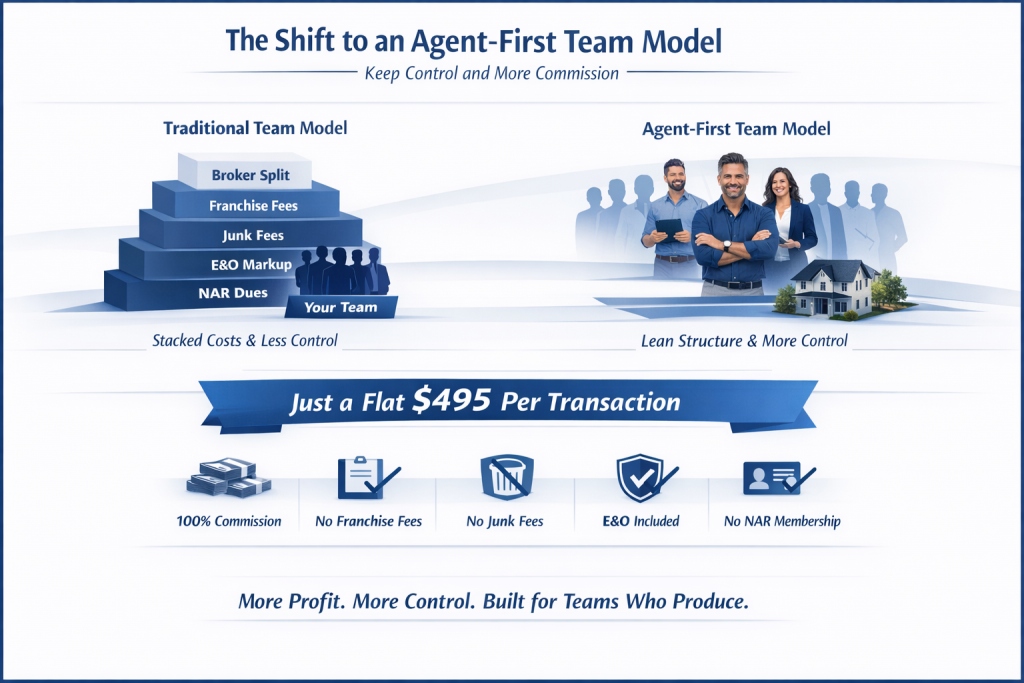
The team model that works today is different.
Instead of stacking splits, it removes unnecessary layers and keeps control where it should be, with the team leader and the agents.
At Easy Realty, the structure is simple.
No brokerage split.
No franchise fees.
No junk fees.
No E&O markup.
No required NAR membership.
Just a flat $495 per transaction.
That changes everything.
What “Control” Actually Means for Team Leaders
Control is not about micromanaging your agents. It is about owning your economics and your structure.
When you remove brokerage-level splits, you decide how your team is structured.
You decide:
What splits make sense for your agents
How to allocate resources for growth
Where to invest in marketing and lead generation
How to reward performance
You are not working around a brokerage model. You are building your own within a clean framework.
How the Math Changes at Scale
This is where the model becomes powerful.
Let’s look at a team doing 100 transactions per year.
| Scenario | Traditional Brokerage | Easy Realty |
|---|---|---|
| Transactions | 100 | 100 |
| Avg Brokerage Cost | $2,000 per deal | $495 per deal |
| Total Annual Cost | $200,000 | $49,500 |
| Capital Saved | — | $150,500 |
That difference is not theoretical.
That is capital that can be reinvested into:
Recruiting stronger agents
Running paid marketing campaigns
Hiring internal support staff
Building systems that scale
Instead of funding brokerage overhead, you are funding your own growth.
Support Without the Overhead
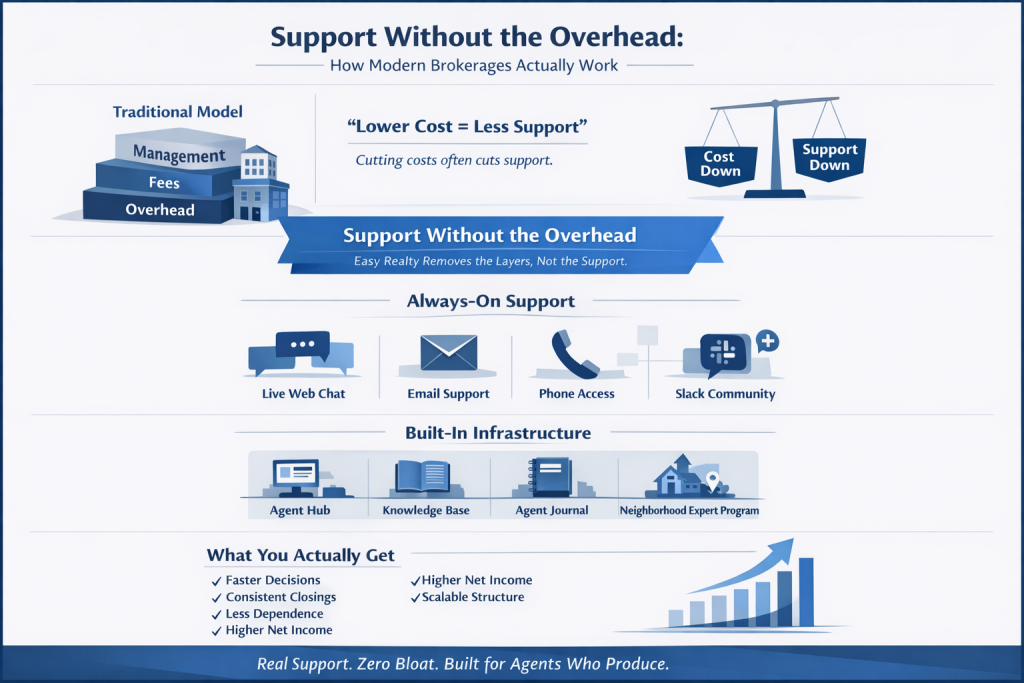
The natural question is whether reducing cost means sacrificing support.
In most cases, that is exactly what happens.
Easy Realty is structured differently.
Support is not tied to overhead. It is built into the system.
Agents and team leaders have access to:
Live web chat for immediate questions
Email support for structured needs
Phone access when needed
Slack community for real-time agent collaboration
On top of that:
The Easy Realty Agent Hub centralizes workflows
The Knowledge Base provides answers and processes
The Agent Journal delivers ongoing education
The Easy Realty Neighborhood Expert Program helps teams scale locally
This creates support without requiring layers of management and cost.
Why This Model Attracts Stronger Agents

Top agents are not looking for brand names.
They are looking at what they keep.
They are evaluating:
How much of their commission stays with them
How fast they can operate
How much support they actually receive
Whether the structure helps them grow
When you offer a team model built on:
100 percent commission
$495 flat fee
No junk fees
No forced memberships
You remove the main objections immediately.
The conversation shifts from justifying cost to explaining opportunity.
Retention Becomes Structural, Not Cultural
Most teams talk about culture as the reason agents stay.
Culture matters, but economics matter more.
If your structure is not competitive, agents eventually leave, regardless of culture.
When your model is clean and predictable, retention improves naturally.
Agents are not questioning what they are paying or where their money is going.
They are focused on producing.
The Simpler Way to Scale
The biggest shift in this model is simplicity.
Traditional teams become complex as they grow.
More agents, more layers, more cost, more management.
The agent-first model stays simple:
Flat fee per deal
Flexible internal structure
Centralized systems
Direct access to support
That simplicity is what allows scale without friction.
The Bottom Line
If you are running a team, you are either scaling efficiently or you are slowly getting compressed by overhead.
There is not much middle ground.
The team model that lets you keep control without getting taxed twice is built on removing unnecessary layers while keeping real support and structure in place.
Easy Realty does that with a single, predictable cost.
$495 per transaction.
No splits at the brokerage level.
No franchise fees.
No junk fees.
Everything else becomes your decision.
And that is what real control looks like.