

When most people think about building a real estate team, they focus on recruiting, branding, and lead generation. Those are all important. But the foundation that determines whether a team actually scales is the brokerage structure underneath it.
If the brokerage is not built for teams, everything becomes harder. Margins compress. Recruiting becomes more difficult. Systems break under pressure. And eventually, the team leader becomes the central bottleneck trying to hold everything together.
A true team-friendly brokerage does the opposite. It removes friction, simplifies economics, and creates an environment where both the team leader and the agents can grow together without unnecessary constraints.
The Problem With Most “Team-Friendly” Claims
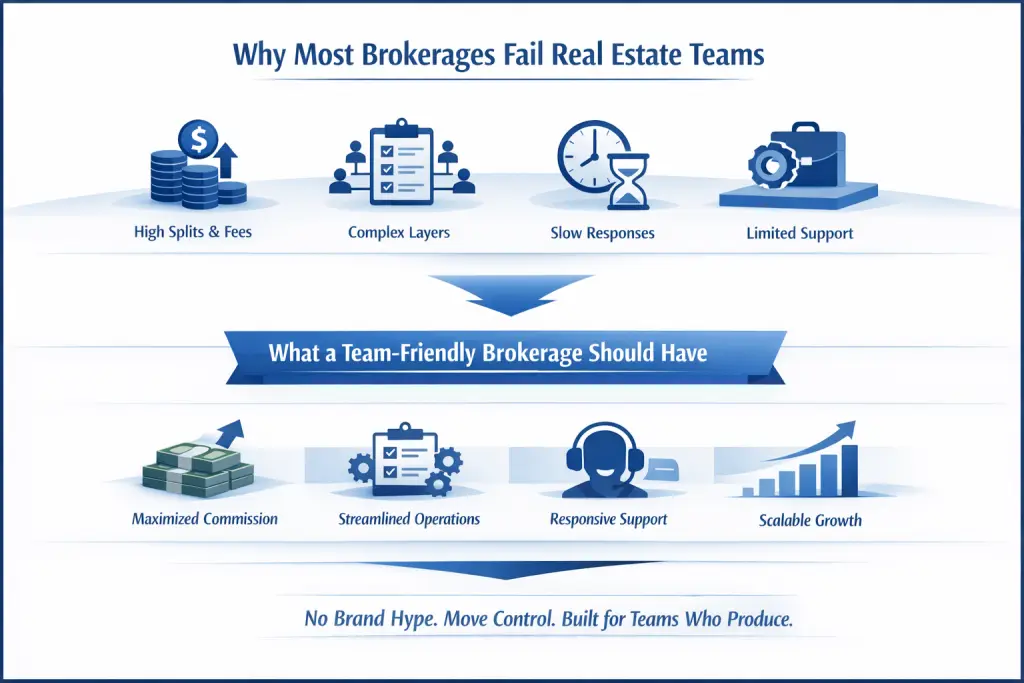
Almost every brokerage will say they support teams. That does not mean their structure actually works for teams.
In traditional franchise models like Keller Williams, RE/MAX, Coldwell Banker, or Compass, the system is still built around individual agents first. Teams are layered into that system, not designed into it.
That creates a mismatch.
| Category | Traditional Brokerage | Impact on Teams |
|---|---|---|
| Commission | Split at brokerage level | Reduces team margins |
| Fees | Franchise + admin + tech | Compounds across agents |
| Structure | Agent-first, team second | Creates inefficiency |
| Support | Manager-driven | Does not scale cleanly |
At small scale, this might feel manageable. As soon as the team grows, the cracks show.
What a Team-Friendly Brokerage Should Actually Do
A brokerage built for teams should solve three core problems:
- It should protect margins as the team grows
- It should reduce operational friction
- It should give the team leader control over structure and economics
If it does not do those three things, it is not truly team-friendly.
Margin Protection at Scale
The first and most important factor is how the brokerage impacts margins.
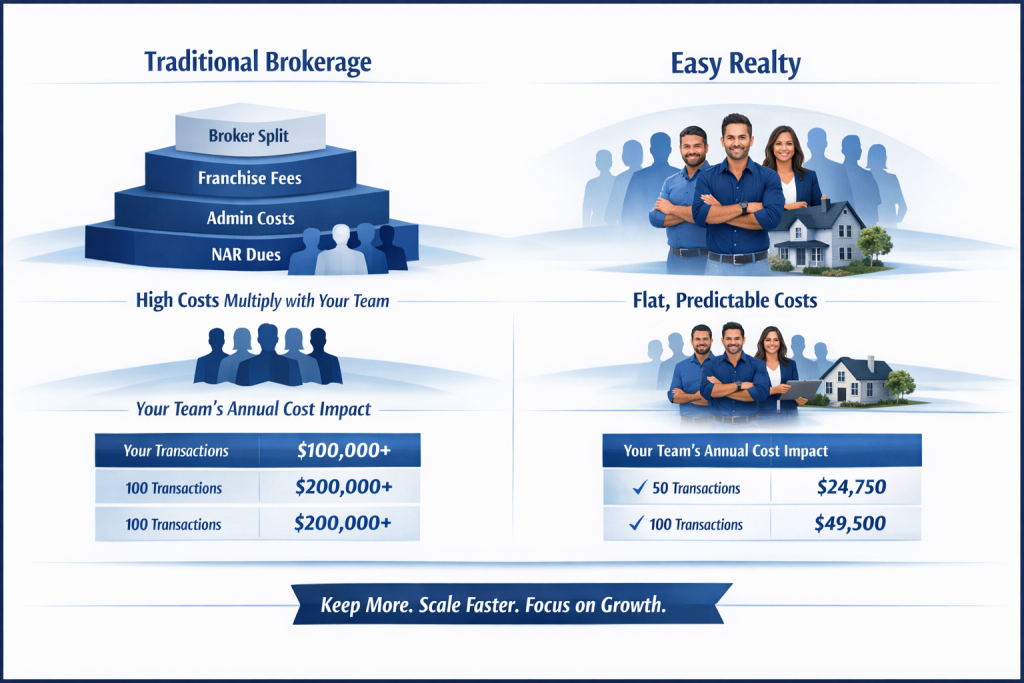
In most traditional models, costs scale with production. That means the more your team produces, the more you pay out in splits, franchise fees, and transaction costs.
That is backwards.
Growth should improve margins, not reduce them.
Compare structures side by side.
| Scenario | Traditional Team | Easy Realty |
|---|---|---|
| Commission | $10,000 | $10,000 |
| Brokerage Split | $2,000 to $4,000 | $0 |
| Franchise + Fees | $500 to $1,500 | $0 |
| Total Cost | $2,500 to $5,500 | $495 |
| Net Before Team Split | $6,500 to $7,500 | $9,505 |
That difference compounds with every agent added to the team.
A team-friendly brokerage protects that margin instead of eroding it.
Eliminating Stacked Costs
Most team leaders underestimate how many layers of cost they are dealing with.
In a traditional structure, you are often paying:
• Brokerage splits
• Franchise fees
• Admin and compliance fees
• Technology fees
• E&O charges
• NAR and association dues
Now multiply that across every agent on your team.
That is where the pressure comes from.
A team-friendly brokerage removes as many of those layers as possible.
At Easy Realty, that looks like:
• No brokerage split
• No franchise fees
• No junk fees
• No E&O markup
• No required NAR membership
Just one predictable number.
$495 per transaction.
That simplicity is what allows team leaders to scale without constantly recalculating their economics.
Control Over Team Structure
In many brokerages, teams operate within constraints that limit flexibility.
There are rules around branding, compensation, support, and systems that are dictated from the top down.
That reduces control.
A team-friendly brokerage should do the opposite. It should give the team leader the ability to design their team structure based on what actually works.
That includes:
• Setting team splits that make sense
• Deciding how to allocate marketing spend
• Controlling branding and positioning
• Defining operational workflows
When the brokerage removes its own layers, control shifts back to the team leader.
Systems That Support Teams, Not Just Agents
One of the biggest failure points for teams is systems.
Most brokerages offer tools, but they are not integrated or designed for team workflows. Agents end up using multiple platforms, communication is scattered, and efficiency drops.
A team-friendly brokerage provides centralized infrastructure.
At Easy Realty, that includes:
• Agent Hub for transaction workflows and operations
• Knowledge Base for instant answers and standardized processes
• Agent Journal for ongoing education and insight
• Slack community for real-time communication and collaboration
This allows teams to operate faster and more consistently.
Instead of building systems from scratch, you plug into ones that already work.
Support That Scales With the Team
Support is another area where traditional brokerages struggle at scale.
Most models rely on managers or brokers as the primary source of support. That creates limitations.
• Response times vary
• Availability is inconsistent
• The system breaks under volume
For a team, this creates dependency. Agents come to the team leader for answers. The team leader becomes overloaded.
A team-friendly brokerage eliminates that bottleneck.
Easy Realty provides multi-channel support:
• Live web chat for immediate questions
• Email support for structured needs
• Phone access when necessary
• Slack community for real-time peer support
This means your agents are not dependent on you for everything. They can get answers quickly and keep moving.
That alone increases team productivity.
Recruiting Becomes Easier
Recruiting is directly tied to your economics.
Top agents are not joining teams for brand names alone. They are looking at what they keep and how the structure supports their growth.
When you are operating inside a high-overhead brokerage, your ability to offer competitive splits is limited.
When your costs are low and predictable, everything changes.
You can offer:
• 100% commission structure
• Clear, simple fees
• Strong support and systems
• A scalable environment
That makes your pitch much stronger.
You are not trying to justify a complex model. You are offering clarity and opportunity.
Retention Becomes Structural
Retention in teams is often treated as a culture issue.
Culture matters, but structure matters more.
If agents feel like they are losing too much of their income, they will leave eventually. It does not matter how strong the culture is.
A team-friendly brokerage creates retention through structure.
• Predictable costs
• Fair splits
• Strong support
• Clear growth paths
When those elements are in place, agents have fewer reasons to leave.
Growth Without Complexity
The biggest advantage of the right brokerage model is simplicity.
Traditional team structures become more complex as they grow.
More agents means more problems, more cost, more management.
A team-friendly brokerage reduces that complexity.
At Easy Realty, the model stays simple regardless of size.
Flat fee per transaction.
Centralized systems.
Multi-channel support.
That consistency allows teams to grow without constantly adjusting their structure.
The Real Test of a Team-Friendly Brokerage
If you want to evaluate whether a brokerage is truly team-friendly, ask a few simple questions.
Does this model improve my margins as I grow, or reduce them?
Does it simplify my operations, or make them more complex?
Does it give me control, or take it away?
Does it support my agents directly, or make me the bottleneck?
The answers will tell you everything you need to know.
The Bottom Line
A team-friendly brokerage is not defined by branding or marketing. It is defined by structure.
It protects your margins.
It removes unnecessary costs.
It simplifies your operations.
It gives you control.
It supports your agents without creating dependency.
Easy Realty is built around those principles.
A flat $495 per transaction.
No franchise fees.
No splits at the brokerage level.
No junk fees.
Just a clean, scalable structure designed for teams that want to grow without being weighed down.
When you operate inside the right model, you stop fighting your brokerage and start building your business.